
When Smoke Fills the California Air: Protecting Your Condo from Fire
Living in a California condo brings a certain peace of mind. You’re often closer to city amenities, maybe you don’t have to worry about yard work, and there’s a community feel. But here’s the thing: that sense of security can vanish in a puff of smoke. Wildfires aren’t just a mountain problem anymore. They’re a California problem, period. And if you own a condo, fire damage is a very real, very expensive threat you absolutely must prepare for.
Honestly, many condo owners don’t fully grasp where their responsibility ends and the HOA’s begins when fire strikes. This misunderstanding can leave you seriously exposed.
Your Condo, Your Risk: What Your HO-6 Policy Actually Covers
Think of your condo insurance, often called an HO-6 policy, as a shield for everything *inside* your specific unit. The walls, the floors, the ceiling finishes – that’s generally your domain. Your personal belongings? Definitely yours. If a fire rips through your building, your HO-6 policy is what steps up to repair or rebuild your interior space and replace your possessions.
But here’s where it gets interesting. It also covers what’s called “Loss of Use” or “Additional Living Expenses” (ALE). Imagine your condo is uninhabitable after a fire. Where do you go? A hotel? A rental? Your policy should pay for those extra costs while your unit is being repaired, up to a certain limit. This isn’t a luxury; it’s a necessity. Nobody wants to be homeless after a disaster, especially not on their own dime.
Which brings up something most people miss. Your HO-6 also typically includes liability coverage. If a fire starts in your unit – say, from a faulty appliance – and spreads, causing damage to other units or common areas, your liability coverage could protect you from lawsuits. It’s a layer of protection you hope you never need, but you’ll be glad it’s there if you do.

The HOA’s Role: The Master Policy and the “Walls-In” Dilemma
Every condo association has a master insurance policy. This policy covers the building’s exterior, the roof, the foundation, and all the common areas – the hallways, the gym, the lobby, maybe even the pool. When a wildfire hits, this master policy is the first line of defense for the overall structure.
But wait — there are different kinds of master policies, and this is where the “walls-in” issue comes into play.
Some master policies are “bare walls-in.” This means they cover the building’s structure up to the unfinished surfaces of your unit’s walls, floors, and ceilings. Everything from the paint inward, including fixtures, cabinets, and flooring, is on you. If your HOA has a “bare walls-in” policy, your HO-6 needs to pick up a lot more slack.
Other HOAs have “single entity” or “all-in” policies. These are more generous, often covering some of the fixtures and improvements within your unit, like standard cabinets or basic flooring. Even with these, though, any upgrades you’ve made – say, granite countertops or hardwood floors – likely aren’t covered by the master policy. Your HO-6 policy needs to cover those upgrades.
The real answer is more complicated than a simple “HOA covers the building, you cover your stuff.” You need to know exactly what your HOA’s master policy covers. Get a copy of it. Read it. Ask questions. It’s the only way to avoid a giant, fiery surprise.
California’s Fiery Reality: Why This Matters More Than Ever
California’s wildfire season isn’t really a “season” anymore. It’s year-round. We’ve seen devastating fires sweep through Ventura County, the Wine Country, the Sierra foothills, and even brush up against the edges of the Inland Empire and the Valley. The 2018 Camp Fire wiped out an entire town. The 2020 Creek Fire burned hundreds of thousands of acres. Experts are already warning about the potential for significant fires in the LA area in 2025. This isn’t fear-mongering; it’s just the reality of living here.
This increased risk has thrown the insurance market into a tailspin. Major insurers like State Farm, Allstate, and Farmers have either pulled back from writing new policies in certain areas or significantly raised premiums. Premiums for some homeowners, including condo owners, jumped 40% between 2022 and 2024. It’s not uncommon for people in high-risk zones to receive non-renewal notices.
So, what happens if you can’t find coverage? Many Californians are forced onto the California FAIR Plan. This is an insurer of last resort, designed to provide basic fire coverage when the traditional market won’t. It’s better than nothing, but it often comes with higher premiums and less comprehensive coverage than a standard HO-6 policy. It’s a safety net, not a first choice.
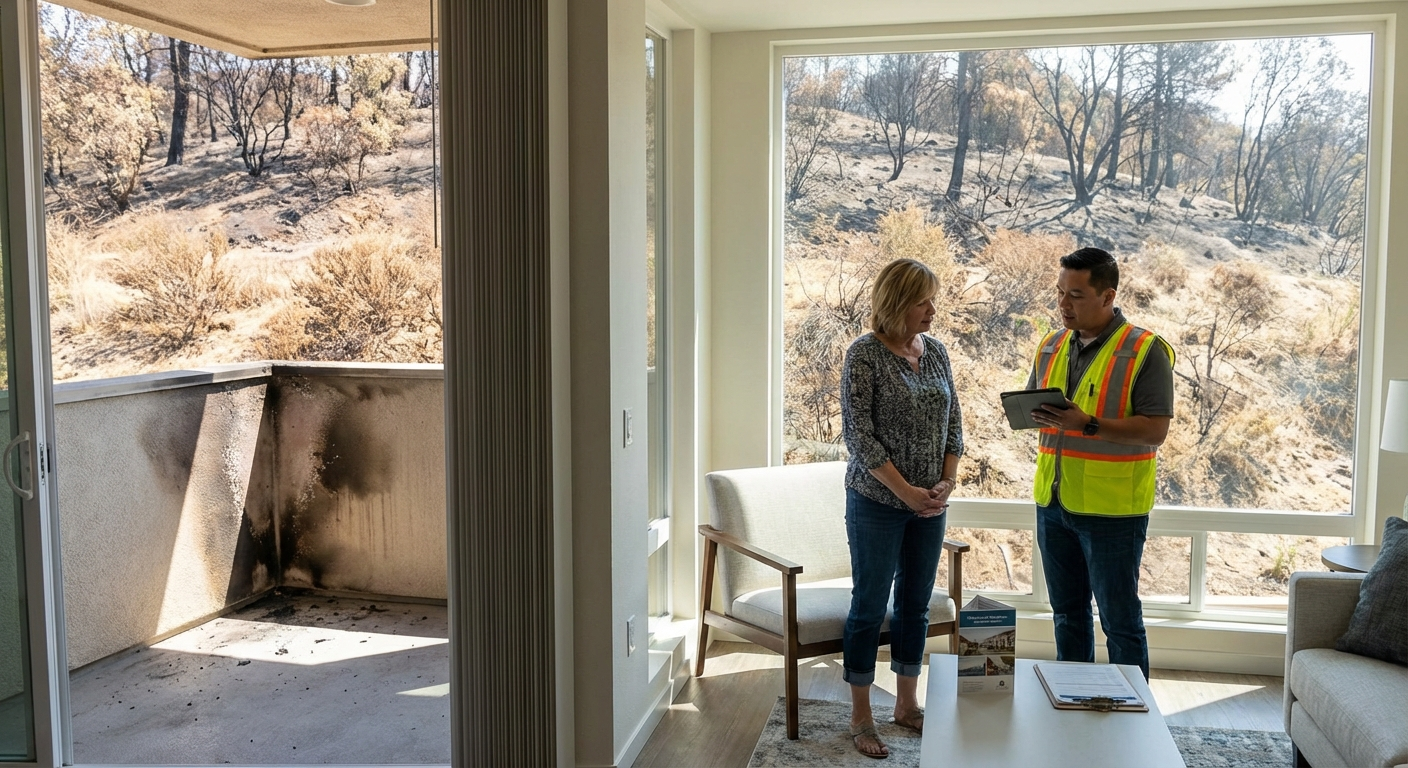
Navigating Deductibles and Loss Assessments
Let’s talk money. Specifically, deductibles. Your HO-6 policy will have one, and the HOA’s master policy will have one too – often a much larger one, sometimes $25,000 or even $50,000. If a fire causes $100,000 in damage to the building, and the master policy has a $50,000 deductible, the HOA has to pay that first.
How do they pay it? Through a “loss assessment” to the condo owners. Every unit owner gets a bill for their share of that deductible. Suddenly, you’re on the hook for thousands of dollars, even if your unit wasn’t directly damaged. Your HO-6 policy can include “Loss Assessment” coverage to protect you from this. It’s a small rider that can save you a huge headache – and a huge chunk of cash. Don’t skip it.
Also, be aware of wildfire deductibles. Some insurers, especially in high-risk areas, are now adding separate, higher deductibles specifically for wildfire claims. This means if a wildfire causes damage, you might pay a percentage of your dwelling coverage amount, not a flat dollar figure. It could be 5% or even 10% of your coverage, which could easily be tens of thousands of dollars. You absolutely need to understand if your policy has one of these.
Getting the Right Protection: Don’t Guess
Finding the right condo insurance in California, especially with fire on everyone’s mind, isn’t a DIY project. You wouldn’t perform surgery on yourself, right? This is similar. You need someone who understands the nuances of HO-6 policies, the different types of HOA master policies, and the ever-changing California insurance market.
That’s where an independent insurance agent comes in. Someone like Karl Susman at California Condo Insurance. He and his team don’t work for one specific insurance company. They work for you. They can compare options from multiple carriers, explain the fine print, and help you understand what you’re actually buying. They know the ins and outs of California regulations, including Prop 103, which governs how rates are approved.
Honestly, getting proper coverage isn’t about finding the cheapest policy. It’s about finding the *right* policy. It’s about making sure that if the worst happens – if a wildfire threatens your home in Santa Clarita or a kitchen fire starts in your building in downtown San Diego – you’re truly protected.
Ready to get clarity on your condo’s fire protection? Get a personalized quote today. Karl Susman and his team are ready to help. You can reach California Condo Insurance at (877) 411-5200. CA License #OB75129.
Click here to start your quote and protect your investment.
FAQ: Condo Insurance and Fire Damage in California
Does my HOA master policy cover fire damage to my unit?
It depends on the type of master policy. A “bare walls-in” policy won’t cover much beyond the structural shell. A “single entity” or “all-in” policy might cover standard fixtures, but usually not your personal belongings or any upgrades you’ve made. You’ll always need your own HO-6 policy for your personal property and often for the interior finishes of your unit.
What if I’m forced onto the California FAIR Plan?
The FAIR Plan is a last-resort option for fire insurance when traditional insurers won’t cover you. It provides basic fire coverage but often at a higher cost and with less comprehensive protection than a standard policy. You might need to purchase a separate “Difference in Conditions” (DIC) policy to fill in gaps like liability or water damage coverage that the FAIR Plan doesn’t include.
How much personal property coverage do I need?
It’s a good idea to create a home inventory – a list of all your belongings with estimated values, photos, or even videos. This helps you determine an accurate coverage amount. Don’t just guess. Many people underestimate the value of their possessions until they have to replace everything.
What’s a wildfire deductible, and do I have one?
A wildfire deductible is a separate, often higher deductible that applies specifically to fire damage caused by a wildfire. Instead of a flat dollar amount, it might be a percentage (e.g., 5% or 10%) of your dwelling coverage. You absolutely need to check your policy documents or ask your agent to see if you have one and what its terms are.
Can I still get coverage if I live in a high-risk fire area?
It’s definitely harder, but not impossible. Many standard insurers have pulled back from high-risk areas. However, an independent agent can often find specialized carriers that still offer coverage, though premiums might be higher. If all else fails, the California FAIR Plan is there as a backstop for fire coverage.
Don’t wait for disaster to strike. Protect your investment now.
Click here to start your quote.
This article is for informational purposes only and does not constitute financial advice.